Come visit with me in my gardens!

Wednesday, May 10, 2006

Rainy Days


My azaleas grow in a woodland setting so I do not manicure them at all; they are allowed to grow as if wild!

We’ve had right much rain lately, and even though the sun is out today, it is still to wet to work in my gardens. I took advantage of a few periods when the rain stopped for a few minutes and ventured out to take some photos.

Rain drops that have settled on the flowers add some interestingness to the images I think! I thought that I would share some of the images I came up with; hope you enjoy!

Click on the images for a larger view!


Sunday, May 07, 2006

The Elegant Wild Geranium


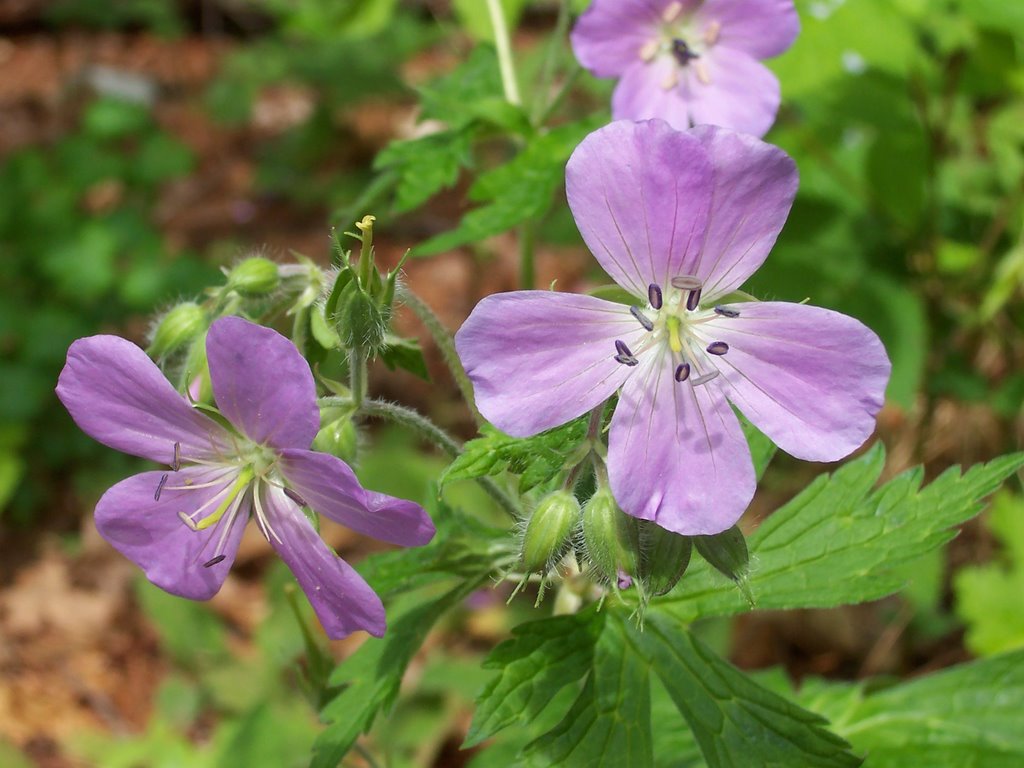
Image: by D L Ennis, Geranium maculatum

While taking a ride on the Blue Ridge Parkway recently, I was surprised to see wild geraniums growing along the side of the road. I couldn’t believe that I had never noticed them before! A closer look revealed that they were the same variety I have growing in my gardens. They are a beautiful little flower, that when grown in large groupings, provide a magnificent display.

Wild Geraniums are North American woodland plant (Geranium maculatum) having rose-purple flowers. They are in the same genus as the annual geraniums people grow in pots but are a much hardier perennial. They grow from tough underground rhizomes and can withstand harsh conditions. Indians ground dried rhizomes into powder to stop bleeding and also to make a medicine for sore throats. At a certain stage the unopened fruit looks like a crane's bill, thus the alternate common name "cranesbill". The flowers open for one or two days. The seeds "pop" from the seed capsule and can fly several yards. They can be manually triggered similar to the way jewel weed can be "popped". The flower has lines on the petals called nectar guides pointing to the center. This supposedly helps pollinating insects find their way to a meal. The flowers progressively go through male and female stages and need a certain kind of wasp to provide transfer the pollen for fertilization.

Color ranges from a very light pink (never white) to magenta. There are said to several additional species not listed here, many of which are annuals or biennials. Flowers of different shades often grow close together.

Image right: by D L Ennis, A closer look at the, Geranium maculatum

Wild Geranium prefers drained soil in open woods where partial sun is possible. It also colonizes areas near roads where the soil is clayish and compacted (such as by heavy machinery). It grows in monospecies patches with plants of height of about 12 inches. Each plant produces three to four 5-petaled flowers on a stalk.

They will survive severe disruption and often returns as fast as dandelions to disrupted areas, though it is not so tolerant of being continually chopped down or eradicated as dandelions are. Transplantation has a high rate of success assuming the tall plants are supported artificially in the first year. The pubescent (hairy) leaves and stems are soft and prone to wilting if water is insufficient.

Please, do not harvest any wild plant, most are available from reputable growers. Let’s leave the wild plants where they are for everyone to enjoy, and so they have the opportunity to spread and repopulate!

First posted on Blue Ridge Gazette.

Technorati Tags:

Saturday, May 06, 2006

When the Wood Thrush Sings


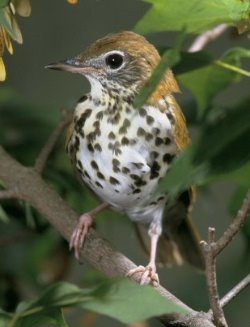
Image: Wood Thrush, in the public domain from USFWS

I walked the forest on the muted light of an early May morn to see what nature had to offer on this new day. The freshness of the deciduous foliage mottled by sprinkles of radiance from the sun peaking through the branches and stippled with beads of dew would be enough to enlighten the soul.

Enticed by the hauntingly beautiful song of the wood thrush, like rats to the Pied Pipers tune, I followed the methodic timbre to its source and my eyes were as delighted as my ears when I spotted my wonderful feathered friend perched on the limb of a maple singing as if only for me. I slowly lowered myself to the ground, my back against a large white pine, and enjoyed his melodious performance until he moved on and only then did I move too.

"That's the wise thrush; he sings each song twice over, lest you should think he never could recapture the first fine careless rapture!" -Robert Browning

The forest floor in these woods is adorned with a lush carpet of creeping cedar and bejeweled, at this time, by the pink lady’s slipper. As I make my way back to my Blue Ridge Mountain home, not far through the woods, I relive the precious moments spent with the wood thrush and know, that come evening, he will sing for me again as I relax in my garden to his stunning song!

The wood thrush holds a special place in my heart and I am always elated with their return to our woods in spring. I will take pleasure in their song until late summer or early autumn, when they leave to winter in the lowland tropical forests of southern Mexico and Central America, and anxiously await their return next year.


You can hear the beautiful song of the wood thrush here.

Crossed posted on Blue Ridge Gazette.


Technorati Tags:

Thursday, April 27, 2006

The Beautiful and Fragrent Peony


Image: by D L Ennis, Peony bud taken last week 04/28/06.

I have been watching the peonies in my gardens this spring, and I have one that is particularly vigorous. It’s in a planter on my deck as are four others all under the same conditions. They are herbaceous peoines; very beautiful and very fragrent!

The flower buds of the peony secrete a sweet substance that the ants like to eat. The good news is that the ants are not harmful to your peonies! The ants don't eat the actual plant and contrary to popular belief, the ants are not required to open the buds.

The peony or paeony (Paeonia) is the sole genus in the flowering plant family Paeoniaceae. There are about 30 species of herbaceous peony and they are perennials that grow 0.5-1.5m tall. However, there are woody shrub peonies that grow up to 2-3m tall. They produce large, often fragrant flowers in shades of red to white or yellow in late spring and early summer. Peonies are native to Asia, southern Europe and western North America. In the past, the Peonies were often classified as a tribe of the Ranunculaceae, along with Helleboreae and Anemoneae.

Image: by D L Ennis, The bud begins to open, taken Tuesday 02/05/06.

The peony is among the longest-used flowers in ornamental culture. Along with the plum, it is a traditional floral symbol of China, where it is called 牡丹 (mǔ dān). In 1903, the Qing Dynasty declared the peony as the national flower. Currently, the Republic of China on Taiwan designates the plum blossom as the national flower, while the People's Republic of China has no legally designated national flower. In 1994, the peony was proposed as the national flower after a nationwide poll, but the National People's Congress failed to ratify the selection. In 2003, another selection process had begun, but to date, no choice has been made.

The famous ancient Chinese city Luoyang has a reputation as a cultivation center for the peonies. Throughout Chinese history, peonies in Luoyang are often said to be the finest in the country. Dozens of peony exhibitions and shows are also annually held there.

Image: by D L Ennis, The peony bud is fully open, taken Thursday 04/05/06

In Japan its name is "Ebisugusuri" "medicine from China"; it is regarded by many Japanese as the king of flowers and is cultivated assiduously. In traditional folk medicine, peony root was used as a treatment for menstrual cramps, asthma and convulsions.

The peony is also the State flower of Indiana. In 1957, the Indiana General Assembly passed a law to make the peony the state flower. It replaced the zinnia, which had been the state flower since 1931.

Peonies are also extensively grown as ornamental plants for their very large, often scented flowers.

Have questions about peonies? Visit here.